Hello
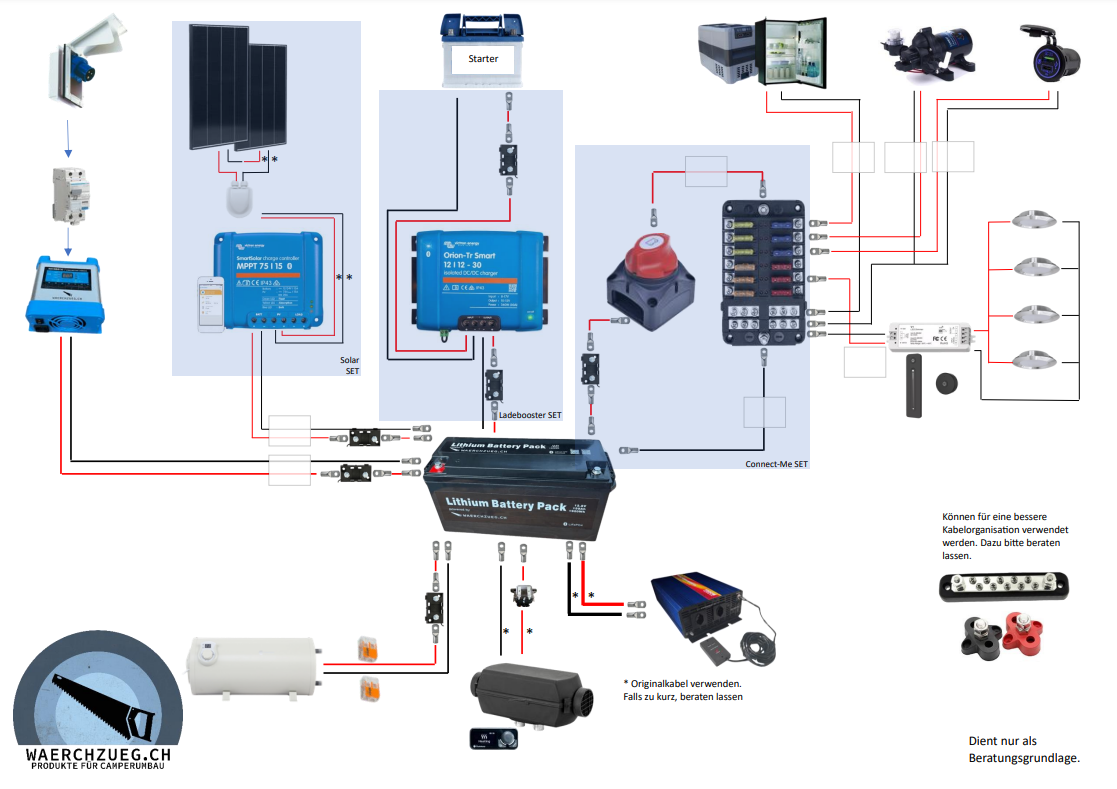
A solar system—there are thousands of positive reviews online. Here’s my take on it, and that’s exactly how I set it up on my own camper. My customers are happy with it, too.
1.) Charge Controller, PWM / MPPT?
Solar charge controllers establish the connection between the solar panel and a battery. As the name “charge controller” suggests, they regulate the charging current to the battery. An IUoU charging curve is standard these days and ensures fast yet gentle charging of a RV battery.
Difference:
If you want to know the details, check this out:
https://www.amumot.de/solar-laderegler-12v-mppt/
In summary:
A PWM charge controller is more cost-effective and isn’t as precise when it comes to power measurement. Technically, this isn’t a problem—slightly less energy flows into your battery. (In the example: 67.5W)(Not suitable for lithium batteries)
An MPPT charge controller is more expensive and is extremely precise when it comes to managing power. This allows it to transfer more solar energy from the cells into your battery. (In the example: 90 W)
Here’s an example:
- 100 Wp produces (for example!!) 18 V and 5 A in the sun (equivalent to90 W)
- With aPWM charge controller, you could charge a 13.5V battery with a 5A charging current. This corresponds to a power output of67.5W(at exactly 13.5V).
- With anMPPT controller, the 5 A and 18 V are converted to battery voltage, and at 13.5 V, 6.66 A (90 W) flows
Personally, I used the cheaper PWM charge controller for two years. It was enough for my cell phone, lights, and cooler.
Since I later installed a 6-liter 12V water heater, I switched to a Victron MPPT 75/15. That was more than enough, too.
However, we now cook using an induction cooktop in the van, so I’ve also installed a 30A charging booster from Victron. We have more than enough power.
2.) Size of the Solar Panels / System Design
Here’s a simple explanation:
A 100-watt module provides approximately 400 watt-hours per day on a sunny day from May through September. So
you’re topping off your “energy tank” with 400 watt-hours every day.
Here’s a rough estimate of typical appliances and their power consumption:
Cell phone: Battery: 12 watt-hours
Apple MacBook Pro: Battery: 60 watt-hours
Compressor cooler: 10 watts per hour (internal temp. 5°, external temp. 30°)
LED lighting: approx. 30 watts per hour Water
pump and other small appliances combined: approx. 100 watts per hour
So, here’s an example:
You charge the following in one day...
a cell phone twice (24 watt-hours)
1 laptop or tablet (60 watt-hours)
Compressor cooler 24 hours x 10 watts (240 watt-hours)
LED lighting: 4 hours × 30 watts (120 watt-hours)
Water pump / other: 0.5 hours × 100 watts (50 watt-hours)
Total: 494 watt-hours
In perfect weather, you generate: 400 watt-hours
As you can see, you can’t be self-sufficient this way. Or rather, your battery is fully charged, so it covers the difference and then discharges after a while.
Also, especially in Switzerland, not every day is sunny. Therefore, make sure to account for a sufficient reserve. The differences between 100 watts and 320 watts aren’t very significant. So, just measure your roof and install as many panels as will fit.
Personally, I’ve installed 260 watts and a 150 Ah lithium battery.
Yes, I even installed the two 130-watt panels CROSSWISE on the roof to leave room for the windows.
With the 260 watts and 150 Ah lithium battery, we’re self-sufficient on the road. We even occasionally recharge our electric bikes in the car.
3.) Solar? Shore power? Alternator dual-battery system?
Shore power:
You install a CEE outlet on the outside of the camper so you can plug in at campgrounds. I don’t
recommend this.
You’re required to install an earth leakage circuit breaker (ELCB) in the camper (still available in my shop, though). These components are expensive and should be wired by a professional.
Dual-battery system:
It sounds simple, but the installation isn’t that straightforward. You tap into your engine/starter battery and run two wires through the driver’s cab to the rear, where your second battery is located. A charge booster or an isolator relay goes in between. I don’t recommend the isolating relay—you can find out why in this video:
Solar panels on the roof alone go a very long way. You need the charge booster to cook with an induction cooktop or as an extra safety measure (redundant system). Even if you’ve been parked under a tree for 2–3 days, you might be glad that the battery can be quickly recharged afterward using the charge booster.
For longer trips, trips mainly to the north, or if you’re living in the van, a charge booster is, of course, a must-have. The charge booster is THE reliable power source.
If you’re unsure: Just start with solar and retrofit the charge booster later if necessary.
Solar:
Solar prices have dropped dramatically in recent years. Installation is quick and easy—check out the video under “Ideas” on my website.
With solar, your battery is always charging! Whether you’re driving or parked at your campsite. A completely worry-free package! You no longer have to worry about your battery. It’s always fully charged. Even if you park in the shade, some power still flows!
I’ve NEVER used my shore power input :-)
4.) Batteries
Be careful with the batteries! Choose a good, suitable battery.
The batteries in my shop are all suitable for RVs and solar systems.
There are about 34 different battery chemistries.
We want at least one AGM battery.
Ideally, like mine, with a deep-cycle function.
If you want to know more, you can read about it here:
https://batteryworld.varta-automotive.com/de-de/gel-batterie-oder-agm-batterie-das-sind-die-unterschiede
AGM battery: Thanks to the gel inside, these are better suited for off-road use and for withstanding vibrations while driving. My batteries have a deep-cycle function, so more of the rated capacity can be utilized.
Lithium Battery: Lithium-ion batteries are used in your cell phone and your bicycle. These have a high energy density and are somewhat delicate to manage.
The most widely used lithium chemistry for campers is therefore the LiFePo4 chemistry/design. These are also used in electric city buses, etc.
If you want to know more about the different types of lithium batteries, give me a call. (NCM, LiFePo4, and where they’re installed; questions about manganese, rare earth elements, etc.)
--> A LiFePo4 battery (lithium iron phosphate) is a safe choice.
Like all lithium batteries, it requires a BMS (Battery Management System). This system monitors each cell individually and provides optimal power to them. Overcharging and undercharging are therefore not possible. (Only due to self-discharge) However, BMS units are always integrated into my batteries.
Lead-acid Batteries <-> Lithium?
Lead-acid
batteries are heavy; the rated capacity is never 100% available—you can subtract about a third. Lead-acid batteries are inexpensive and easy to handle. Depending on the application, they last between 3 and 5 years.
(Capacity decreases over the years, and the battery eventually fails.)
Lithium batteries are much lighter, and they deliver 100% of their rated capacity (often even 105%). Lithium batteries are more expensive and, under normal use, easily last 7–10 years. (After this time, they still retain 80% of their original capacity.) Thanks to their built-in intelligence, it’s practically impossible to damage them.
So it comes down to budget. I recommend a 100Ah lithium battery.
Otherwise, 1x 150Ah AGM or larger—see my shop.
For induction cooking or if you want to draw more than 1500W from the battery for an extended period (more than 3 minutes), you should use a 150Ah lithium battery or larger.
5.) Electrical Wiring
Don’t worry—12V wiring is easier than you think.
It’s just that, in my opinion, there aren’t any YouTube videos or websites that explain it in a way that everyone can understand.
That’s why I have a showroom in Winterthur with a complete wiring setup. Come on by—I’ll show you how it’s done. For free.
I can explain the following points to anyone so that they can build it themselves afterward:
Solar panels, shore power, dual battery systems, batteries, main fuse, individual fuse boxes, wire gauges, crimping wires, positive/negative polarity questions, faucet wiring, pumps, lights, refrigerators/coolers, etc.