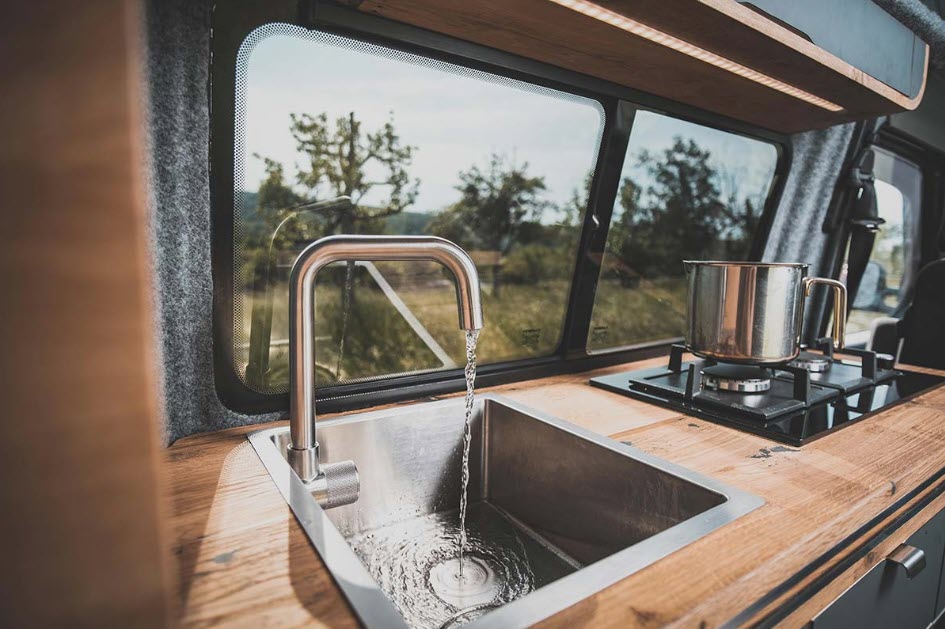
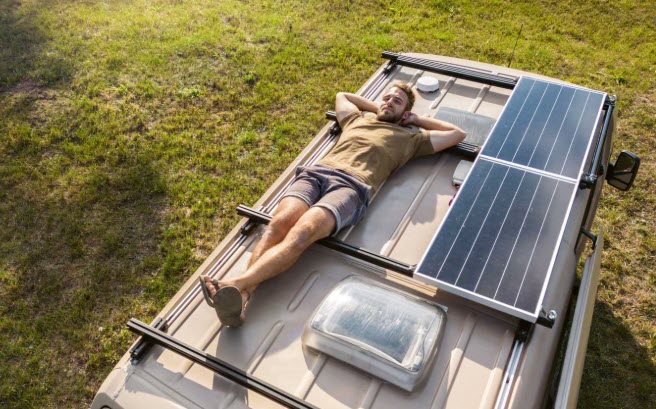
Anyone planning a camper conversion in Switzerland will quickly find that when it comes to gas, there are extra efforts, costs, and inspections involved. That’s exactly why it’s worth designing the camper’s interior to be gas-free from the very beginning. In many cases, this is easier, more affordable, and quicker to implement.
With a clean 12V setup consisting of a LiFePO4 battery, solar panel system, charge booster, inverter, and induction cooktop, you can build a camper today that works better for everyday life than a traditional gas-powered setup.
1. Gas in a camper means paperwork, inspections, and follow-up costs
If you want to register a camper with gas in Switzerland, you must have a gas inspection performed if the gas capacity is 500 grams or more. Important: This refers to 500 grams, not 0.5 liters.
There’s another point to consider: These days, it’s virtually impossible to simply install a gas system yourself and then have it inspected later. In practice, a gas inspector will often only approve what a licensed gas installer has installed. There are cases where you can discuss the project with a gas inspector in advance, and they may still approve it for you. However, you must clarify this beforehand.
It’s also important to note that the gas inspector must be able to inspect and assess the entire installation. Gas hoses hidden behind paneling or in areas that aren’t visible are therefore a problem. Anything that isn’t visible and clearly traceable makes the inspection more difficult.
2. Below 500 grams, the camper conversion becomes significantly easier
With less than 500 grams, the effort involved in this area is significantly reduced. That’s exactly why a solution using our 450-gram gas cartridge is appealing. With the right regulator, you can set up a simple and compact cooking solution without going through all the hassle of a traditional gas installation.
For many projects involving camper conversions, camper builds, or camper renovations, this is by far the more practical approach.
3. For camper registration, you need a fixed cooking unit
For registration, you normally need a permanently installed cooking unit.
A cartridge stove that you simply pull out of a drawer and place on the countertop when needed is generally not sufficient. In some cases—and especially with smaller vehicles—there may be exceptions. However, this depends heavily on the inspector.
If you want to plan carefully, assume the following:
- The cooking unit must be permanently installed
- The solution must be transparent and verifiable
- Portable appliances are usually not a viable solution for certification
This is exactly where a gas-free camper conversion gets interesting: A permanently installed induction cooktop often serves the purpose better from a technical standpoint.
4. Gas isn’t just more expensive to install—it’s also more expensive over the years
A gas inspection in Switzerland costs about 110 to 140 CHF and must be repeated every 3 years.
Over a 12-year lifespan, that adds up to a significant amount. And that’s just the inspection. Not yet factored in are:
- Installation costs
- any necessary adjustments during inspection
- Additional costs for a gas installer or special parts
If you’re investing in an electric camper, a camper battery, and charging infrastructure anyway, gas is often simply the less economical option.
5. In a camper kitchen, less is usually enough than you think
Many kitchens in camper van conversions are planned to be too large. The reality is usually simpler: you’ll cook the big meals outside. Inside, you mainly need a compact, clean, and quick solution for standard meals, coffee, tea, or pasta.
For many conversions, 1 to 2 stovetops are therefore perfectly sufficient.
This saves:
- Space in the cabinetry
- Weight
- Installation effort
- Complexity throughout the entire system
6. For outdoor use, you’ll often end up buying a separate cartridge stove anyway
Most people who convert a camper end up buying a separate outdoor stove sooner or later anyway—one that runs on gas cartridges weighing less than 500 grams.
This makes sense, because cooking outdoors offers more flexibility, is more enjoyable, and often provides more power. You’re allowed to carry larger cylinders as long as they aren’t connected. For registration purposes, the stove that’s permanently installed and connected is what matters.
That’s why a clear separation often makes sense:
- inside: fixed, road-legal cooking solution
- outside: portable cartridge stove for everyday use
7. Gas refrigerators hardly make sense anymore
Another consideration in camper interior design is the refrigerator. Gas-powered refrigerators, known as absorption refrigerators, are no longer attractive options in our view.
They aren’t really efficient for everyday use. That’s exactly why we haven’t sold gas refrigerators for years.
We consistently rely on compressor refrigerators. From a technical standpoint, this is the better solution today for a modern camper refrigerator, RV refrigerator, or 12V camper refrigerator.
8. Modern electrical systems are what make a gas-free camper truly attractive
Prices for lithium systems have dropped significantly. At the same time, solar systems for campers have improved considerably. That’s exactly why you can now build a powerful, practical, and clean setup that’s completely gas-free.
Our recommendation for a practical setup:
- Solar system with at least 200 watts
- It becomes practical and comfortable starting at 300 watts
- 120Ah or 200Ah LiFePO4 battery (or more)
- A 30A or 50A charge booster, depending on the vehicle and alternator
We wouldn’t recommend starting with less than 200 watts of solar power. In many cases, that doesn’t provide enough and is hardly worth the effort.
9. LiFePO4 batteries and induction work well together technically
Depending on the system, a 12V LiFePO4 battery can deliver a continuous load of about 150A or 200A. That roughly corresponds to 2,000 to 2,500 watts.
It’s important to note: Some manufacturers list higher values. While the BMS may allow this under certain conditions, the physical limits of the connections at the terminals will eventually be reached. This is precisely why the system as a whole must be properly sized.
The basic rule is simple:
- The battery determines what is realistically feasible over the long term
- The inverter should be compatible with this
- The cooktop must not constantly overload the battery
A realistic setup, for example, is:
- 1 LiFePO4 battery
- 1x compatible inverter
- 1x 1,800-watt induction cooktop
That’s more than enough for cooking, coffee, and tea.
10. Two cooktops are also possible, but only with the right system
If you want two cooking zones, you’ll need to design the setup specifically for that.
An induction cooktop with two zones shouldn’t just be installed in a camper without careful consideration. The combined power output is crucial. For example, we offer two-zone induction cooktops with 2,800 watts of combined power. For a well-planned installation, this is much more realistic than appliances with extremely high power ratings.
A suitable setup for this would be:
- 2x 120Ah LiFePO4 batteries (or 2x 200Ah)
- 3,000-watt inverter
- 2-burner induction cooktop with 2,800 watts of combined power
11. Going gas-free is often even cheaper than using gas
Many people get it wrong. They think: Induction requires a large electrical system, so it automatically costs more. In practice, that’s often not true.
Because if you’re installing the following anyway:
- LiFePO4 battery
- Charging booster
- Solar system
- Inverter
then switching to an induction cooktop is often more cost-effective than a complete gas system removal, which involves registration issues, inspections, and follow-up costs.
That’s exactly why a gas-free camper conversion is the better choice in many cases today:
less effort, fewer connections, fewer inspection concerns, and greater practicality for everyday use.
Conclusion: A gas-free conversion is the better solution for many campers
If you’re planning a new camper conversion today, you shouldn’t automatically assume gas is the standard. In Switzerland, in particular, gas quickly becomes a source of inspection and cost concerns.
A gas-free system with:
- LiFePO4 battery
- Camper electrical system
- Solar system
- Charging booster
- Inverter
- Induction cooktop
- Compressor Refrigerator
is often easier to install, more cost-effective over the long term, and more convenient for everyday use.
For many projects involving camper conversions, camper construction, and camper interior design, this is now the technically superior solution.
Frequently Asked Questions About Gas-Free Camper Conversions
Do I need a gas inspection in Switzerland for every gas stove in my camper?
No. This requirement applies only to gas quantities of 500 grams or more. For amounts below that, the effort involved is significantly less.
Is a portable cartridge stove sufficient for camper registration?
Usually not. For registration, you generally need a fixed cooking unit.
Do gas refrigerators still make sense?
In our opinion, no. Compressor refrigerators are the better solution today for a modern camper refrigerator.
How much solar power makes sense for a camper?
We wouldn’t start with less than 200 watts. Starting at 300 watts, the setup becomes much more practical for everyday use.
Which battery is best for induction cooking in a camper?
For simple setups, a LiFePO4 battery paired with a compatible inverter and a 1,800-watt induction cooktop works very well. For two cooking zones, you’ll need two batteries and a larger inverter—in other words, a larger system.